How to read this page
A life from the ledger.
This page sticks to sourced facts.
1893 wheel story · HeritagePress and public recordSources and collections
1859–1864
Galesburg, and a borrowed name.
He was the ninth of ten children of George Washington Gale Ferris Sr. and Martha Edgerton Hyde.[1, Item 8, Statement of Significance][2, pp. 515–516][3, pp. 32–34][4][5, p. 60]Henry B. Nason’s 1887 Rensselaer biographical register — compiled in Ferris’s lifetime, and the closest thing to an autobiographical statement that survives — gives the same Galesburg birth, the same parents, and a year-by-year career to 1886.[2, pp. 515–516]
The family record says George Sr. was named for the Rev. George Washington Gale, Silvanus Ferris’s friend and co-founder of Galesburg and Knox College; the engineer inherited the full name.[4]Knox College’s 1912 anniversary history names Silvanus Ferris among the first trustees elected on 7 January 1836 and among the purchasing committee; the family compilation places him with Gale among the colony’s founders.[4][6, p. 22][6, p. 22 and plate caption][7]
By that compilation, George Sr. was born at Norway, New York, on 14 May 1818, the youngest son of Silvanus, and married Martha Edgerton Hyde in Knox County in September 1840.[4]
1864–1876
A Carson City boyhood.
In 1864 George Sr. sold the Galesburg farm and took his wife and eight of the ten children by wagon to Carson City, Nevada, a journey of nearly five months. George Jr. was five.[1, Item 8, quoting S. Allen Chambers Jr. (HABS)][4][5, p. 127]
The family home at Third and Division Streets in Carson City was listed on the National Register in 1979 as the G. W. G. Ferris House and is now known as the Sears–Ferris House.[1, Item 8; NRIS record 79003438][4][8, Section 8][9, p. 3]The Register amendment records that Gregory Sears built the house in 1863 and that Ferris purchased the property on 10 March 1868.[8, Section 8][9, p. 3]
On 29 April 1870 the Carson Daily Appeal described fruit and shade trees “on the premises of Mr. G. W. G. Ferris, Third Street the old Sears place.”[8, Section 8][9, p. 3]
1873–1881
Oakland, then Rensselaer.
At fourteen he was sent away to school. Nason records an Oakland, California, military academy from 1873 to 1876, then entry to Rensselaer Polytechnic Institute in September 1876. He graduated in civil engineering in 1881.[1, Item 8][2, pp. 515–516][5, p. 50][5, p. 64][5, p. 48][5, p. 125]
1881–1886
Railroads, coal, and the Ohio River.
Nason’s 1887 register records his first work with the J. H. Ledlie Company: New York office work in 1881, then railroad location in West Virginia.[2, pp. 515–516][5, pp. 47–49][10]The same register, which Richard G. Weingardt later quotes, records a year as chief engineer and then general manager of a West Virginia coal company, including three 1,800-foot tunnels.[2, pp. 515–516][5, p. 49]
Nason’s register and Weingardt both place him on the Henderson Bridge over the Ohio (1883–85), first on its foundations and then inspecting its steel in Pittsburgh; the National Register nomination likewise records his turn to bridge building and steel inspection.[1, Item 8][2, pp. 515–516][5, pp. 51–54]From April 1885, Nason records, he inspected Pittsburgh iron and steel for the Kentucky and Indiana Bridge Company.[2, pp. 515–516][5, pp. 54–55]
1886–1891
Pittsburgh firms, a marriage, Arch Street.
In 1886, aged twenty-seven, he founded G. W. G. Ferris and Company, Consulting and Inspecting Engineers, in Pittsburgh, with James C. Hallsted as his first partner.[1, Item 8][2, pp. 515–516][3, pp. 32–34][5, p. 55]His partners’ 1897 memorial records an 1889 reorganisation in which D. W. McNaugher became a partner.[3, pp. 32–34][5, p. 55]
With Gustave Kaufman he formed Ferris, Kaufman & Company in 1889; the Engineers’ Society of Western Pennsylvania records the Ninth Street Bridge in Pittsburgh as theirs, and Weingardt adds the Central Bridge at Cincinnati (opened 1 September 1891).[3, pp. 32–34][5, pp. 60–67][12]Ferris was elected to membership in that society in June 1891.[12]
His partners’ 1897 memorial and Weingardt both date the marriage to Margaret Ann Beatty of Canton, Ohio, to 18 September 1886; the National Register nomination names her as his surviving wife.[1, Item 8][3, pp. 32–34][5, p. 57][5, p. 67]Pittsburgh’s landmarks foundation records a historic designation (2001) of the Arch Street house associated with the Ferrises; Weingardt places them in Allegheny after the 1886 marriage.[5, p. 57][11]
1891–1893
Chicago, a challenge, and a wheel.
Weingardt places his Chicago office in the Rookery Building and describes his firm, alongside Robert W. Hunt’s, inspecting steel for the fair’s buildings.[5, pp. 67–68, 70][5, p. 78]In his 1893 deposition, as quoted by Weingardt, Ferris said he had ridden a small wooden wheel at Atlantic City in September 1890 without knowing it was a Somers wheel.[5, p. 65][13][14]
Luther Rice’s 1901 account places Daniel H. Burnham’s challenge to American engineers — something to rival the Eiffel Tower, not a tower — at an engineers’ luncheon early in 1891; the Carson City nomination gives 1892.[5, pp. 70–72][10, pp. 475–480]Rice’s recollection has Ferris sketching the wheel at a dinner with friends; Ferris himself, in 1893 newspaper interviews, said he sketched the plan at a Chicago chop-house lunch. The two tellings are both on the record; neither is collapsed into the more cinematic version.[5, p. 74][10, pp. 475–480][15, p. 2, 'The Great Ferris Wheel'][16, p. 2]
Rice and Ferris’s own 1893 account date the board’s concession to 16 December 1892, less than four months before the fair opened; Weingardt dates a formal agreement to 29 November.[5, pp. 79–81][10, pp. 475–480][15, p. 2]The first revolution came at six o’clock on the evening of 9 June 1893. The Wheel opened to the public on 21 June. Opening-day papers agree that Hunt presided, Ferris spoke, and the Iowa State Band played from a car; they disagree on whether the start was at 3 or 4:30.[5, p. 85][5, pp. 88–92][17][18, p. 2, 'The Triumph of Engineering'][19, p. 1, 'The Wheel Goes Round'][20, p. 5]
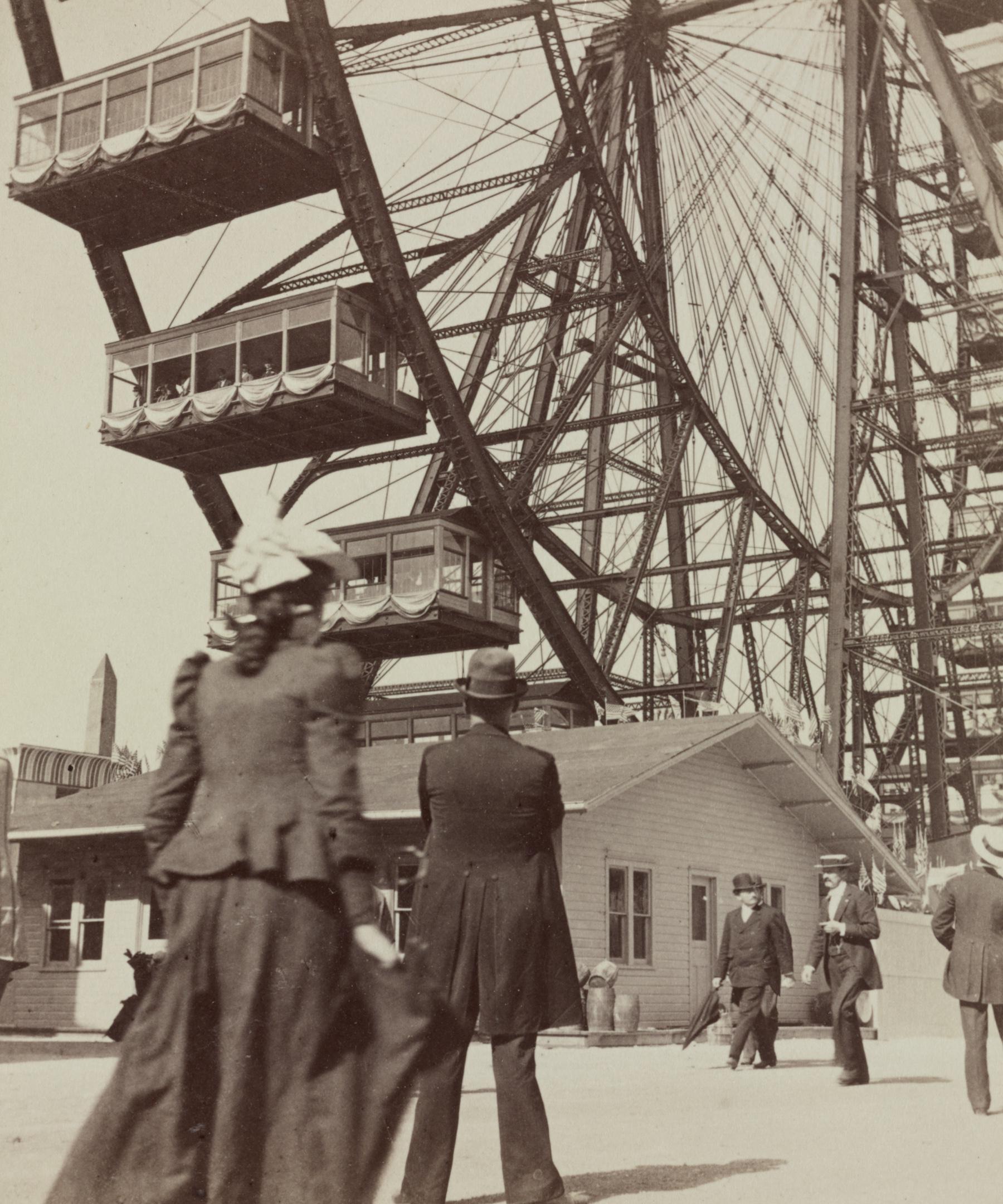
The machine itself — dimensions, cars, power, lighting, and the figures that still disagree — is treated on the 1893 Exposition wheel page. How it went from proposal to operating structure is treated on Building the Wheel. Whether he invented the machine type, and what existed before it, is answered on Who Invented the Ferris Wheel?
1893–1896
Suits, Clark Street, and a shortened career.
Weingardt records the Garden City company’s patent suit being served the day after the opening, with Ferris’s first deposition on 10 July. A matching National Archives file has been located and not read; the service date is not independently confirmed. Weingardt has the suit dismissed on 3 July 1894 with $26.50 costs to Ferris, and states that Ferris never patented the Wheel. A 23 November 1893 New Jersey paper reported that the highest court had found infringement and royalties due. The outcome stays in dispute.[5, pp. 93–94][5, p. 107][5, p. 96][13][14][21, p. 3]
George Sr. died at Riverside, California, on 20 April 1895, and Martha on 23 March 1897; both rest at Olivewood Cemetery.[4][5, p. 109][5, p. 116]Weingardt traces the Wheel’s re-erection at North Clark Street in 1895–96 and the neighbourhood opposition; the Illinois courts’ own history records the 1896 Supreme Court ruling that kept the park from selling liquor.[5, pp. 108–111][22]
By November 1896, Weingardt records, he had sold his engineering firms to his partners. Weingardt writes that by 1896 the couple had separated (p. 111). No contemporary legal filing confirming a separation has been read here.[5, p. 111]
November 1896
Death, funeral, and the ashes.
He died of typhoid fever at Mercy Hospital, Pittsburgh, on 22 November 1896, aged 37. (The family record gives 28 November, the date of the trade-journal issue that carried his obituary; every other source read gives the 22nd.)[1, Item 8][3, pp. 32–34][5, pp. 111–112][23, p. 1][24, p. 3 (dateline Pittsburg, 22 Nov.)][25, p. 6][26][27]
He was cremated after a service on 24 November 1896. Papers in 1898 reported the ashes still held at Samson’s crematory for unpaid claims; the family record itself says they are unaccounted for.[4][5, pp. 114–115][28, p. 2][28, p. 2, 'Ferris' Ashes Held for Debt'][29, p. 6][29, p. 6, 'Ashes Held for a Debt']A later Pennsylvania state article says a brother collected the ashes after fifteen months; the family compilation still records them as unaccounted for. Both statements are given.[4][30]
An 1898 Washington Evening Star item reported a $25,000 insurance policy already exceeded by claims. Weingardt adds that little else remained, and that his heirs at law were his mother and brothers rather than his estranged wife.[5, pp. 112, 115][28, p. 2]
After 1896
What the name carried.
Rensselaer conceived its Alumni Hall of Fame in 1995 and inducted Ferris in that inaugural class in September 1998. Weingardt (p. 125) gives 1995 as the induction year.[5, p. 125][31]The machine that carries his name is treated as its own subject, not as a footnote to the life. The shorter public narrative remains on the heritage hub.
Continue with the 1893 Exposition wheel, how it was built, the season at the fair, or the family before the Wheel. This page does not describe a current institutional affiliation.
FAQ
Dates and the career, in short form.
When was George Ferris born?
In Galesburg, Illinois, on 14 February 1859 — the date in Henry B. Nason’s 1887 Rensselaer biographical register, compiled in Ferris’s lifetime from a questionnaire he returned. The family record also preserves a variant of 16 February. Both dates stay on the page.[1, Item 8, Statement of Significance][2, pp. 515–516][3, pp. 32–34][4][5, p. 60]
How did George Ferris die?
Of typhoid fever, at Mercy Hospital, Pittsburgh, on 22 November 1896, aged 37. Contemporaneous obituaries the next day give that morning. The family record gives 28 November, which is the cover date of the trade-journal issue that carried his obituary.[1, Item 8][3, pp. 32–34][5, pp. 111–112][23, p. 1][24, p. 3 (dateline Pittsburg, 22 Nov.)][25, p. 6][26][27]
When did George Ferris die — 22 or 28 November?
The 22nd is the date in contemporary papers and in his partners’ 1897 memorial. The 28th is the family compilation’s date, matching the Engineering and Mining Journal issue that carried the obituary. The conflict is partly resolved toward the 22nd; the 28th stays on the record as the family/trade-journal date.[1, Item 8][3, pp. 32–34][5, pp. 111–112][23, p. 1][24, p. 3 (dateline Pittsburg, 22 Nov.)][25, p. 6][26][27]
What happened to George Ferris’s ashes?
He was cremated after a service on 24 November 1896. Papers in 1898 reported the ashes still held at Samson’s crematory more than a year later against unpaid funeral claims. A later Pennsylvania state article says a surviving brother retrieved them after fifteen months; the family compilation still records the cremains as unaccounted for. Both statements are given.[4][5, pp. 114–115][28, p. 2][28, p. 2, 'Ferris' Ashes Held for Debt'][29, p. 6][29, p. 6, 'Ashes Held for a Debt'][30]
When was George Ferris inducted into the RPI Alumni Hall of Fame?
Rensselaer conceived its Alumni Hall of Fame in 1995 and inducted Ferris in that inaugural class in September 1998. Weingardt (p. 125) gives 1995 as the induction year. That is the wrong year; the Institute’s own pages date the first induction to September 1998.[5, p. 125][31]
Was George Ferris a bridge engineer before the 1893 Exposition wheel?
Yes. Nason’s 1887 register records work with J. H. Ledlie in 1881–82, a year as engineer and manager of a West Virginia coal company in 1882, the Henderson Bridge over the Ohio in 1883–85, and inspection for the Kentucky and Indiana Bridge Company from 1885. He founded G. W. G. Ferris and Company in Pittsburgh in 1886 and Ferris, Kaufman & Company in 1889, which the Engineers’ Society of Western Pennsylvania records on the Ninth Street Bridge.[1, Item 8][2, pp. 515–516][3, pp. 32–34][5, pp. 47–49][5, p. 49][5, pp. 51–54][5, pp. 54–55][5, p. 55][5, pp. 60–67][10][12]